

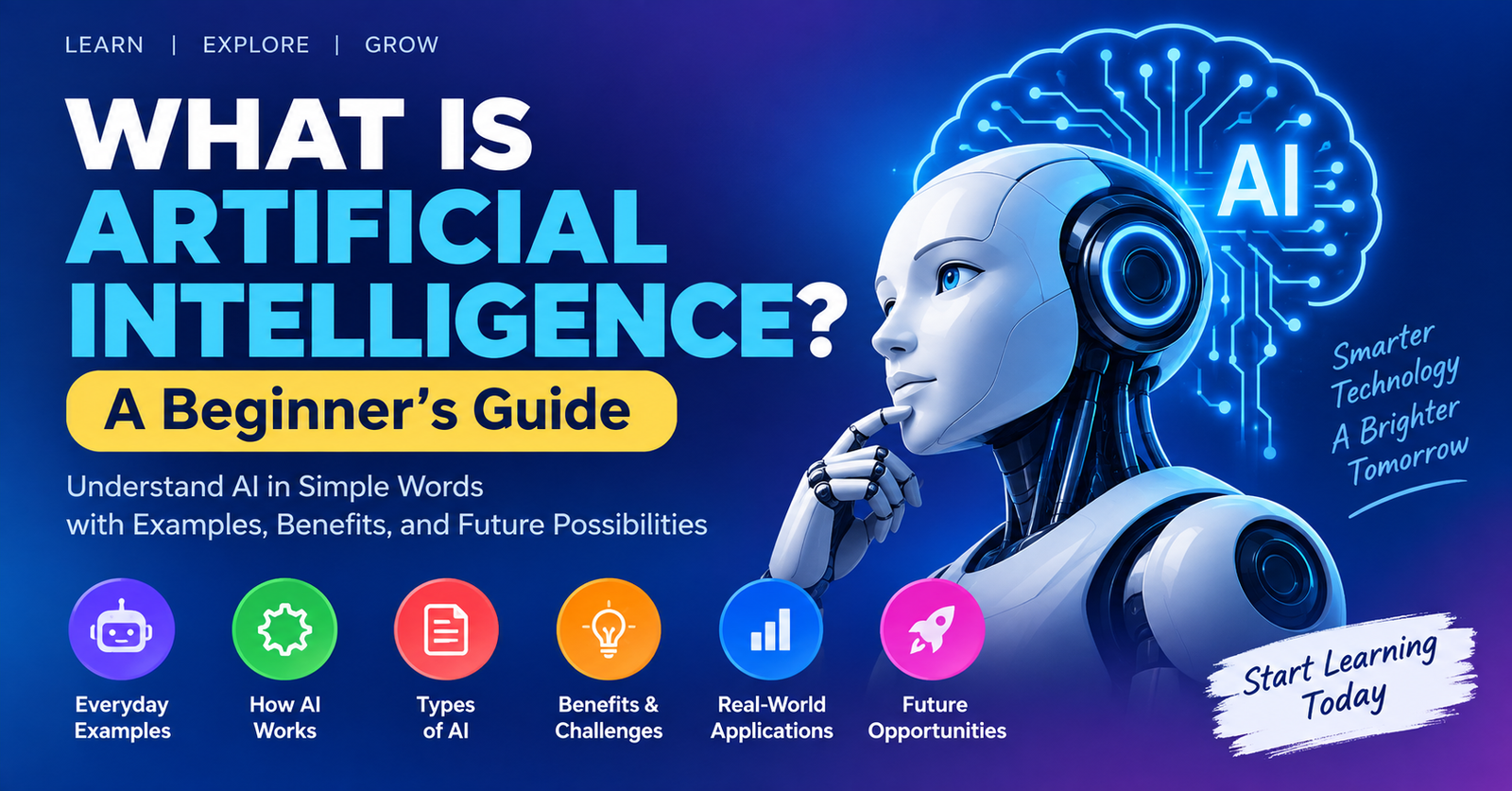
Artificial Intelligence, also called AI, has become one of the most popular technologies in the world.
Today, AI is used in smartphones, websites, mobile applications, cars, banking systems, hospitals, online shopping platforms, and many other places.
You may already be using Artificial Intelligence every day without even realizing it.
For example, when YouTube recommends a video, Google Maps suggests the fastest route, or your phone unlocks using your face, Artificial Intelligence may be working behind the scenes.
But what exactly is Artificial Intelligence?
In this beginner’s guide, we will understand Artificial Intelligence in very simple English. We will also learn how AI works, its types, examples, advantages, disadvantages, applications, and future opportunities.
What Is Artificial Intelligence?
Artificial Intelligence is a technology that allows computers and machines to perform tasks that normally require human intelligence.
These tasks can include:
- Understanding language
- Recognizing images
- Solving problems
- Making decisions
- Learning from data
- Predicting results
- Answering questions
- Creating text, images, audio, and videos
In simple words:
Artificial Intelligence teaches computers how to perform intelligent tasks.
For example, when you ask an AI chatbot a question and it gives you an answer, Artificial Intelligence is being used.
What Does AI Mean?
AI stands for:
A – Artificial
I – Intelligence
Artificial means something created by humans.
Intelligence means the ability to understand, learn, think, solve problems, and make decisions.
Therefore, Artificial Intelligence means:
Human-created intelligence used in machines and computer systems.
Simple Example of Artificial Intelligence
Suppose you have an email account.
Every day, you receive many emails.
Some emails are important, while others may be spam.
An AI-powered email system can analyze different emails and automatically move suspicious messages into the spam folder.
The system learns from previous data and patterns.
This is a simple example of Artificial Intelligence.
How Does Artificial Intelligence Work?
Artificial Intelligence mainly works by using data, algorithms, and computer processing power.
Let us understand it step by step.
Step 1: Collect Data
AI systems need data to learn.
The data may include:
- Text
- Images
- Videos
- Audio
- Numbers
- Customer information
- Website activity
- Historical records
For example, if we want to build an AI system that can identify cats, we may provide thousands of cat images.
Step 2: Process the Data
The computer analyzes the provided data.
It looks for patterns, similarities, differences, and relationships.
For example, an image recognition system may learn common features of a cat such as:
- Eyes
- Ears
- Face shape
- Fur
- Body structure
Step 3: Train the AI Model
The AI system is trained using the collected data.
During training, the system learns how to identify patterns and make predictions.
The more useful and accurate the training data is, the better the AI system may perform.
Step 4: Test the Model
After training, developers test the AI model using new data.
For example, they may show the system a cat image that was not part of the original training data.
The AI then tries to identify whether the image contains a cat.
Step 5: Give Results
Once trained properly, the AI model can perform tasks such as:
- Answering questions
- Predicting prices
- Detecting fraud
- Recognizing images
- Translating languages
- Recommending products
Types of Artificial Intelligence
Artificial Intelligence can be divided into different types.
The three commonly discussed categories are:
1. Narrow AI
Narrow AI is designed to perform a specific task.
It is also called Weak AI.
Examples include:
- Voice assistants
- Recommendation systems
- Face recognition
- Email spam filters
- AI chatbots
- Translation tools
Most AI systems available today are examples of Narrow AI.
2. Artificial General Intelligence
Artificial General Intelligence is usually called AGI.
AGI refers to a theoretical AI system that could perform a wide range of intellectual tasks at a human-like level instead of being designed mainly for one narrow task.
Such a system could potentially:
- Learn different subjects
- Solve different types of problems
- Understand complex situations
- Adapt to new tasks
AGI is an area of ongoing research and discussion.
3. Artificial Superintelligence
Artificial Superintelligence, sometimes called ASI, is a theoretical concept where AI would exceed human intelligence across many areas.
It could potentially be better than humans at:
- Problem solving
- Scientific research
- Planning
- Learning
- Decision making
Artificial Superintelligence does not currently exist.
What Is Machine Learning?
Machine Learning is an important part of Artificial Intelligence.
Machine Learning allows computers to learn from data instead of requiring developers to manually program every possible situation.
For example, suppose we want to identify fraudulent banking transactions.
Instead of creating thousands of fixed rules, a Machine Learning model can study previous transactions and learn patterns connected with fraud.
It can then analyze new transactions and identify suspicious activity.
Artificial Intelligence vs Machine Learning
Many beginners think AI and Machine Learning are exactly the same.
They are related, but they are not identical.
Artificial Intelligence is the larger concept of making machines perform intelligent tasks.
Machine Learning is one method used to build AI systems.
You can think about it like this:
Artificial Intelligence → Machine Learning → Deep Learning
AI is the broader field.
Machine Learning is a part of AI.
Deep Learning is a specialized area within Machine Learning.
What Is Deep Learning?
Deep Learning is a type of Machine Learning that uses structures called neural networks.
These systems are inspired loosely by the way biological brains process information.
Deep Learning is commonly used for:
- Image recognition
- Speech recognition
- Natural language processing
- Computer vision
- Generative AI
- Autonomous systems
Deep Learning usually requires large amounts of data and powerful computing resources.
What Is Generative AI?
Generative AI is a type of Artificial Intelligence that can create new content.
It can generate:
- Text
- Images
- Code
- Music
- Audio
- Videos
- Presentations
Instead of only analyzing existing information, Generative AI can produce new outputs based on user instructions.
For example, you may ask an AI system:
“Write an email requesting leave from my manager.”
The AI can generate the email for you.
Examples of Artificial Intelligence in Daily Life
Artificial Intelligence is already part of our daily lives.
Here are some common examples.
1. Google Search
Search engines use AI to understand search queries and provide relevant results.
2. YouTube Recommendations
YouTube studies your watch history and activity to recommend videos you may enjoy.
3. Netflix Recommendations
Streaming platforms can recommend movies and shows based on your viewing activity.
4. Google Maps
Navigation apps can analyze traffic information and suggest suitable routes.
5. Face Unlock
Many smartphones use AI-powered image recognition to identify a user’s face.
6. Email Spam Detection
Email providers use automated systems to detect spam and suspicious messages.
7. Online Shopping
Shopping websites may recommend products based on browsing behavior and previous purchases.
8. Voice Assistants
Voice assistants can understand spoken commands and perform tasks.
Examples of tasks include:
- Setting alarms
- Playing music
- Checking information
- Sending messages
- Creating reminders
9. Banking
Banks can use AI for:
- Fraud detection
- Customer support
- Credit assessment
- Transaction monitoring
10. AI Chatbots
AI chatbots can help users:
- Find information
- Write content
- Learn programming
- Summarize documents
- Generate ideas
- Solve problems
Applications of Artificial Intelligence
Artificial Intelligence is used in many industries.
AI in Healthcare
AI can assist healthcare professionals in areas such as:
- Medical image analysis
- Patient monitoring
- Drug research
- Administrative automation
- Health data analysis
AI should support qualified medical professionals rather than replace professional medical judgment.
AI in Education
Artificial Intelligence can support students and teachers.
Some uses include:
- Personalized learning
- Automated quizzes
- Language learning
- Homework assistance
- Study material generation
- Learning recommendations
Students can use AI as a learning assistant, but they should still understand the subject and verify important information.
AI in Banking and Finance
Financial organizations may use AI for:
- Fraud detection
- Risk analysis
- Customer service
- Transaction monitoring
- Financial forecasting
- Document processing
AI in Business
Businesses can use Artificial Intelligence for:
- Customer support
- Marketing
- Sales analysis
- Data analysis
- Email automation
- Document processing
- Report generation
AI can save time by automating repetitive tasks.
AI in E-Commerce
Online stores may use AI for:
- Product recommendations
- Customer behavior analysis
- Chatbots
- Inventory planning
- Personalized advertising
- Fraud prevention
AI in Transportation
AI can support:
- Traffic prediction
- Route optimization
- Driver assistance
- Logistics planning
- Fleet monitoring
AI in Manufacturing
Manufacturing companies can use AI for:
- Quality inspection
- Predictive maintenance
- Production planning
- Robotics
- Inventory management
AI in Software Development
Developers increasingly use AI for:
- Code suggestions
- Debugging
- Documentation
- Testing
- Learning new technologies
- Generating boilerplate code
- Explaining errors
AI can make development faster, but developers should still review and understand generated code.
Benefits of Artificial Intelligence
Artificial Intelligence offers many benefits.
1. Saves Time
AI can automate repetitive tasks.
This allows people to focus on more important work.
2. Works Quickly
AI systems can process large amounts of data much faster than manual processing.
3. Reduces Repetitive Work
Tasks such as data entry, classification, sorting, and basic customer support can often be automated.
4. Provides 24/7 Support
AI-powered systems can operate throughout the day without normal human working-hour limits.
5. Helps in Decision Making
AI can analyze large datasets and provide useful patterns or predictions.
However, important decisions should still include human review.
6. Improves Productivity
Employees can use AI tools to complete routine tasks more efficiently.
7. Personalizes User Experience
AI can recommend content based on individual preferences.
Examples include:
- Videos
- Products
- Music
- Courses
- Articles
Disadvantages of Artificial Intelligence
Artificial Intelligence also has limitations and risks.
1. AI Can Make Mistakes
AI systems are not always correct.
They may generate inaccurate or misleading information.
Important information should always be verified.
2. Job Roles May Change
Automation may reduce the need for some repetitive tasks.
At the same time, AI can create new roles and change existing jobs.
Learning new skills will become increasingly important.
3. Privacy Concerns
Some AI systems process large amounts of user data.
Organizations must protect personal information and follow privacy and security rules.
4. Bias
If an AI system is trained on biased or incomplete data, its results may also contain bias.
Developers must carefully test AI systems.
5. Security Risks
AI can also be misused.
Examples include:
- Fake content
- Phishing
- Fraud
- Automated cyberattacks
- Misinformation
Security controls and responsible use are therefore important.
6. Overdependence on AI
People should not depend on AI for every task.
Human knowledge, experience, creativity, judgment, and critical thinking are still very important.
Will Artificial Intelligence Replace Humans?
This is one of the most common questions about AI.
AI may automate some tasks, but many jobs contain multiple responsibilities that require human judgment, communication, creativity, leadership, physical work, or emotional understanding.
Instead of thinking only:
“AI will replace people.”
A more useful question is:
“How can people learn to work effectively with AI?”
People who understand their field and know how to use AI tools responsibly may become more productive.
Jobs That May Use More AI
AI may become increasingly useful in professions such as:
- Software development
- Accounting
- Digital marketing
- Graphic design
- Data analysis
- Customer support
- Education
- Finance
- Healthcare
- Engineering
- Content creation
- Cybersecurity
In many cases, AI will act as a tool that helps professionals complete their work.
Skills You Should Learn for the AI Era
You do not need to become an AI scientist to benefit from Artificial Intelligence.
Some useful skills include:
- Basic computer skills
- Excel
- Data analysis
- Programming
- Communication
- Problem solving
- Critical thinking
- Prompt writing
- AI tool usage
- Cybersecurity basics
For developers, useful technologies may include:
- Python
- JavaScript
- SQL
- APIs
- Machine Learning
- Cloud Computing
What Is an AI Prompt?
A prompt is an instruction or question given to an Artificial Intelligence system.
For example:
“Explain Artificial Intelligence in simple English.”
This is a prompt.
A better prompt could be:
“Explain Artificial Intelligence in simple English for a beginner. Include examples from daily life.”
Clear prompts usually help AI systems understand what type of output you want.
Simple Prompt Formula for Beginners
You can create useful prompts using this basic structure:
Role + Task + Context + Output Format
Example:
“You are a programming teacher. Explain HTML to a beginner using simple English and practical examples.”
Here:
Role: Programming teacher
Task: Explain HTML
Context: Beginner
Format: Simple English with examples
How Can Beginners Start Learning AI?
If you are completely new to Artificial Intelligence, you can follow this learning path.
Step 1: Learn Computer Basics
Understand:
- Files and folders
- Internet
- Browsers
- Software
- Basic computer terminology
Step 2: Understand Artificial Intelligence
Learn:
- What is AI?
- Machine Learning
- Deep Learning
- Generative AI
- Natural Language Processing
- Computer Vision
Step 3: Start Using AI Tools
Use AI tools for simple tasks such as:
- Asking questions
- Writing emails
- Summarizing notes
- Learning concepts
- Generating ideas
Step 4: Learn Prompt Writing
Practice giving clear instructions to AI tools.
Compare different prompts and understand how the output changes.
Step 5: Learn Python
Python is one of the most popular programming languages used for Artificial Intelligence and Machine Learning.
Start with:
- Variables
- Data types
- Conditions
- Loops
- Functions
- Lists
- Dictionaries
- Classes
Step 6: Learn Data Handling
Learn:
- Excel
- SQL
- CSV files
- Data cleaning
- Basic statistics
AI and Machine Learning depend heavily on data.
Step 7: Learn Machine Learning
After learning Python, you can study:
- Supervised learning
- Unsupervised learning
- Regression
- Classification
- Clustering
- Model training
- Model testing
Step 8: Build Small Projects
Practice is very important.
You can build beginner AI projects such as:
- Spam message detector
- House price prediction system
- Student marks predictor
- Customer support chatbot
- Image classifier
- Recommendation system
Future of Artificial Intelligence
Artificial Intelligence is expected to become more deeply integrated into software, workplaces, education, healthcare, finance, transportation, and everyday devices.
In the future, we may see more:
- AI assistants
- Intelligent automation
- AI-powered software
- Personalized education
- Advanced robotics
- Smarter healthcare systems
- Automated business workflows
- AI-supported programming
However, responsible AI development will remain important.
Organizations and developers need to consider:
- Privacy
- Security
- Accuracy
- Transparency
- Bias
- Human oversight
Artificial Intelligence FAQ
What is Artificial Intelligence in simple words?
Artificial Intelligence is technology that allows computers and machines to perform tasks that normally require human intelligence.
What is the full form of AI?
AI stands for Artificial Intelligence.
Is ChatGPT Artificial Intelligence?
Yes. ChatGPT is an AI-based system designed to understand and generate language.
Is AI difficult to learn?
Basic Artificial Intelligence concepts are not difficult to understand.
You can start without advanced mathematics or programming.
For advanced Machine Learning and AI development, programming and mathematics become more important.
Do I need coding to learn Artificial Intelligence?
No.
You can learn basic AI concepts and use many AI tools without coding.
However, programming knowledge is useful if you want to become an AI or Machine Learning developer.
Which programming language is best for AI?
Python is one of the most widely used programming languages for Artificial Intelligence and Machine Learning.
Can AI replace programmers?
AI can automate some programming tasks, but software development also requires system design, problem solving, testing, business understanding, security, and decision making.
Developers who learn how to use AI effectively can use it as a productivity tool.
What is the difference between AI and Machine Learning?
Artificial Intelligence is the broader field of creating intelligent computer systems.
Machine Learning is a part of Artificial Intelligence that helps computers learn from data.
Is Artificial Intelligence safe?
AI can be useful when designed and used responsibly.
However, AI systems may create risks involving privacy, misinformation, security, bias, and incorrect information.
Human supervision remains important.
Conclusion
Artificial Intelligence is becoming an important part of modern technology.
From smartphones and search engines to banking, healthcare, education, business, and software development, AI is already helping people perform many tasks faster and more efficiently.
If you are a beginner, you do not need to learn everything at once.
Start with the basics.
Understand what Artificial Intelligence is.
Learn how AI works.
Use AI tools.
Practice writing prompts.
Then slowly move towards Python, data analysis, Machine Learning, and real projects.
Artificial Intelligence is not only a topic for engineers or researchers.
Students, developers, accountants, teachers, business owners, marketers, and many other professionals can learn how to use AI in their daily work.
The best way to start is simple:
Learn AI, experiment with it, verify its answers, and use it responsibly.